Aberdeen's Bingham Hotel
A South Dakotan was the first to manage Aberdeen's only hotel
4/7/20264 min read
The 1910s were a time of promise in southwest Bingham County. The Aberdeen Branch Railroad was completed in 1910, the same year the American Falls Canal was finished and turned over to the water users, who renamed it the Aberdeen-Springfield Canal. A bridge across the Snake had just been built at Tilden to link the Aberdeen-Pingree area, now irrigable, to the market town of Pocatello, shrinking the travel mileage to eight for those in Sterling and Springfield.
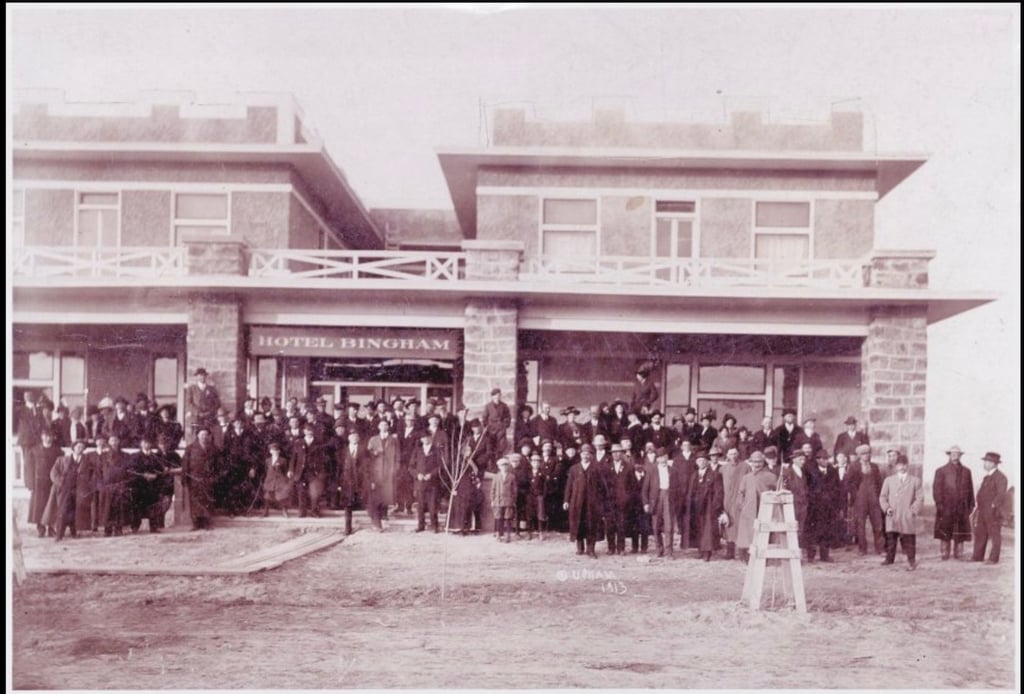
Speculators built Pingree, equipping it with a hotel. Bothwell and McConaughy, who were arguably the major players behind the ultimate success of the American Falls Canal, built the Lakeside Hotel and a Presbyterian Church in Springfield. Local men created the town of Sterling, moving the village of Otis just down the bluffs to its present location, while a very short-lived town just two miles down-track, called Rochelle (after the hometown of Glenn Bothwell in Illinois), sprang up trackside, too. And at Aberdeen, the Aberdeen Townsite Company, created by Frederick Sweet, another major player in the American Falls Canal's creation, built the Bingham Hotel, pictured above.
The first operators, C.G. Fargo and his family, of the hotel came from Hot Springs, South Dakota and had previously managed the Hotel Fargo before taking over the locally famed Gillespie Hotel, pictured below.
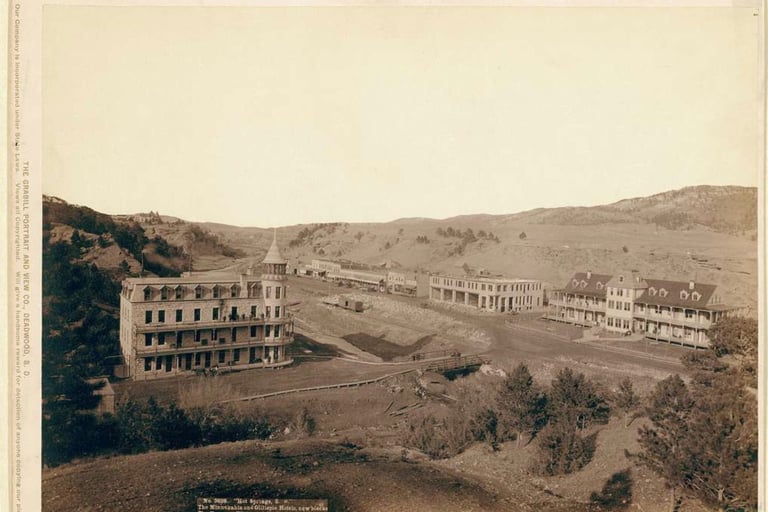
The Gillespie possessed seventy-five rooms in a city that claimed to be "different" than South Dakota's rough and tumble mining towns that included Deadwood and Lead. The town discouraged drinking, gambling and prostitution in an effort to draw both vacationers and those seeking rehabilitation for ailments by using the hot springs of the area. The proscription against drinking may have just been window dressing, given that Fargo was once charged with "selling liquor to an Indian."
The mining population of South Dakota included a great number of Finlanders at the time, an exodus occuring at the turn of the century as Finland was attempting to establish its independence, breaking away from a rapidly deteriorating Russia. Fargo, who was not directly from Finland, was nonetheless well-acquainted with the population and upon his arrival in Aberdeen used his connections to lure in Ben Hastie, who was born in Finland, and thirty other Finnish families to the area.
Fargo was a busy man, acquiring land in Twin Falls in 1908, building a mercantile in Hot Springs in 1913 at the same time his wife and daughter began running Aberdeen's Bingham Hotel. The picture below is of Aberdeen's 'business district' in 1909, so you might imagine Fargo's mind as having more of an imaginative than realistic bent.
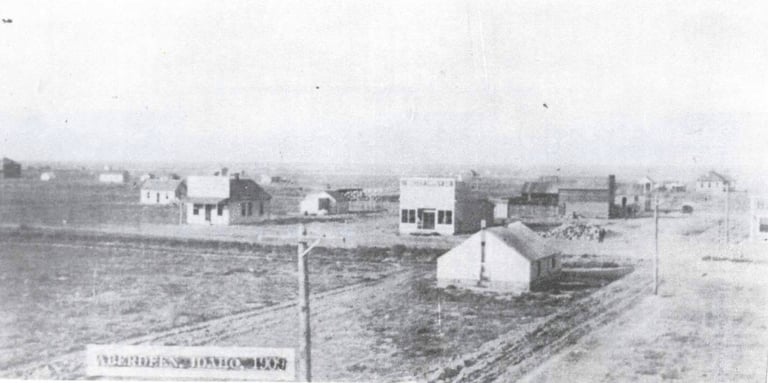
Fargo wrote back to his hometown in November of 1913 that his daughter was serving breakfast for twenty-five in the thirty room hotel and was expecting two hundred that evening. The hotel had only been open seven days. He was scouting for land at the time and bought 160 acres adjoining the Aberdeen townsite, then platted it in ten acre sections with the notion of selling the plats to fruit growers, an interest of his that eventually suited him better at his Twin Falls location, where he brokered Twin Falls peaches and apples before settling into bartering and marketing hay.
Fargo was offering the small acreages to his Finnish acquaintances in Lead and Deadwood for a small down payment with the remainder at six percent interest in one, two, or three year contracts, suggesting the value of the land would double each year. He claimed that nearby land was going for $150 an acre (roughly six thousand dollars in today's purchasing power) and similar land was selling at a thousand dollars an acre in Twin Falls—perhaps a bit of a stretch.
He was also pushing the rumor that the Aberdeen Branch Railroad would soon continue onward at the behest of the Northwestern railroad system, connecting Aberdeen to the Oakley Branch before heading into Nevada and completing a line from Lander, Wyoming to San Francisco.
Fargo and Hastie together urged the thirty Finnish families from South Dakota, which was experiencing a drought statewide and locally was suffering the effects of a major labor strike at the Homestake Mine, its leading metals production site (forty-one million ounces of gold and nine million ounces of silver would be drawn from the claim), to the area in early 1914, and though their migration was noted in newspapers across the nation, little is left of their trek save the tragic end for one of the group. John Heikkila, who had six daughters, homesteaded a portion of the land now located on Stecklein Road, southeast of Springfield, and died of typhoid fever the following spring.
The Bingham Hotel would be noted as being the main draw for an Aberdeen Townsite raffle in 1914, which also listed as winnings the following properties: 14 bungalows and lots valued at $16,800 each; a $5000 alfalfa mill; two forty-acre farms; 16 five-acre tracts; seven two-and-a-half acre tracts, 1309 residential lots (valued at $150 each); and 150 business lots. Tickets were $150 each. As seemed to be par for the course at the time (and admittedly is par for the course today, as well), the speculators overstated the area's qualities when they advertised, claiming the temperatures never got below twenty-three degrees and never rose above 81.
The marketing focus leaned toward Montana, and a special train ran from Butte to Aberdeen for the drawing. Con Cream, an Irishman, won the hotel and later traded it for a farm—perhaps Ed Leisy's, as he would soon be owning, according to accounts, the Bingham Hotel in 1917. The hotel was still operating in 1940 and even as late as 1967 was in some sense open, as Little League boys were urged to register there.