Anti-German Sentiment at Aberdeen and Taber
German speaking in Bingham County came under fire during WWI
2/21/20268 min read
It was certainly a case of bad timing.
The meeting at American Falls in March of 1916, intended to form a German Society, came less than ten months after the Germans' sinking of the Lusitania with 128 Americans on board. That event strained the U.S. position of neutrality—a stance decried by many as being a lie, given the U.S. was selling weapons to the Allies in addition to providing massive loans. When Germany gave the go-ahead for their sea fleet to sink U.S. merchant ships, even the pretense of neutrality evaporated, and the U.S. declared war on Germany on April 6, 1917 just a year after local Germans, many of them Mennonites, formed their group.
Nearly four hundred people attended the German Society meeting, ninety-three of them signing the membership roll. Bingham County, which Power County had been broken off of just three years prior, had boasted 319 German born citizens in the 1910 Census, along with 449 first-generation Germans—the meeting must have included a goodly portion of that total. Mennonites numbered a great many of those attending, predictably so, given their centuries-long clutching at their heritage.
In 1763, Russia's German-born czarina Catherine the Great had offered Germans land on the Volga and near the Black Sea, allowing them tax-free existence, exemptions from military service, and the right to keep their language and culture intact. Thousands of Mennonites, a "peace religion" that emphasized "turning the other cheek" rather than fighting, and other Germans took up the offer, generally maintaining communities sealed from their surroundings, marrying within their group and keeping their ways intact. Not until the late 1860s, when the Russian government, fresh from freeing the serfs and initiating democratic reforms, pulled that century old set of promises and started pressing for Russification did the Mennonites have to worry about being bothered. But when the policy changes came, many set off for America during the next forty years, ten to fifteen thousand in the 1870s alone, until the Russian Revolution and subsequent World War ended emigration. Kansas and Canada were the Mennonites' landing points initially, and when the American Falls canal system was near completion and Idaho opened up lands nearby, a great many came to the area.
At the local German Society meeting, several speakers addressed the large crowd. Richard Warwas, a professor of arts at the Idaho Academy, stressed that loyalty to the mother country didn't imply disloyalty to the U.S., and implored the attendees to bolster the German reputation of industriousness. Martin Radke, a long time outspoken area dry farmer, exhorted the community to teach their children German. "Ten minutes a day," he said, would give their children a working knowledge of the mother tongue. Boise's Gustav Kroeger, speaking in German as did his predecessors at the podium, said "there is room in our hearts for the Fatherland" and as Americans they have a right to oppose politicians. The U.S. was not neutral, he said, but is funding those fighting Germany. Judge A.C. Haag, who was appointed President of the Society, pointed out that over 200,000 Germans, 300,000 sons of Germans, and a quarter million more of German extraction had fought for the Union forces in the Civil War.
Among the attendees was George Funk, a grandson of Jacob Funk, who with his brother Peter carried $50,000 in cash from Russia to Kansas in 1873, risking theft during treks across two continents and an ocean, then haggled Santa Fe Railroad land prices down from $4 an acre to $2.50 and bought sizable holdings. About that time, 2,000 other Mennonites were pulling into Kansas, drawing local derision until it was discovered they carried $2,250,000 in gold—$75 million in today's currency, much of it to be infused into the local economy. In all, between 120,000 and 300,000 Volga and Black Sea Germans came to the U.S., though just several thousand of them were Mennonites.
Most of the other Southeast Idaho Mennonites could echo the Funk family's trip from Russia, if not match their wealth. The Enns had escaped from Ukraine to Germany and then stopping at Kansas before coming to Aberdeen in 1906. The Fasts: Prussia to Kansas in 1893, Aberdeen in 1906. The Giesbrechts: Germany to Nebraska to Paso Robles, California to Aberdeen in 1910. Harders: Prussia to Kansas. Heges: Germany to Nebraska in 1892, then to Paso Robles, in 1902, Aberdeen eight years later.
Russia to the Dakotas, Prussia to Canada. Siberia to Oregon. to Colorado, before ending up between Aberdeen and American Falls. Many others tried to make a dry farm go of it in Dubois before the severe drought of 1919 and the resultant poverty drove them out. Their journeys—part religious, part economic— echoed the difficulties of a corresponding set of Bingham County settlers, the Mormons who were collecting on the newly built Peoples Canal to the north.
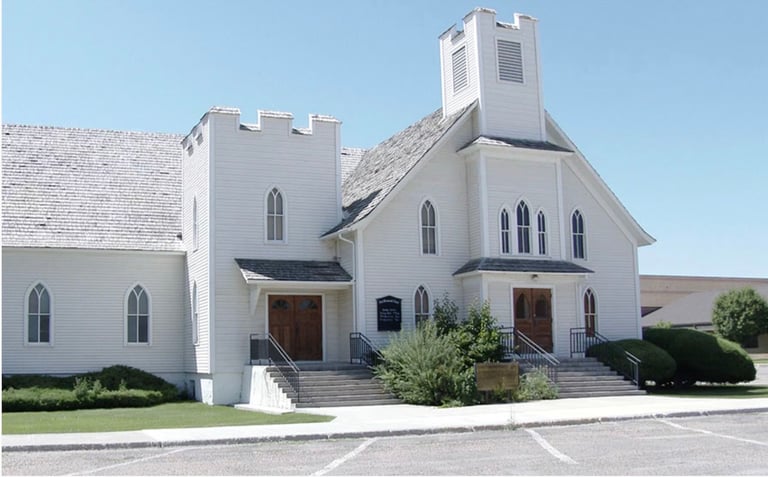
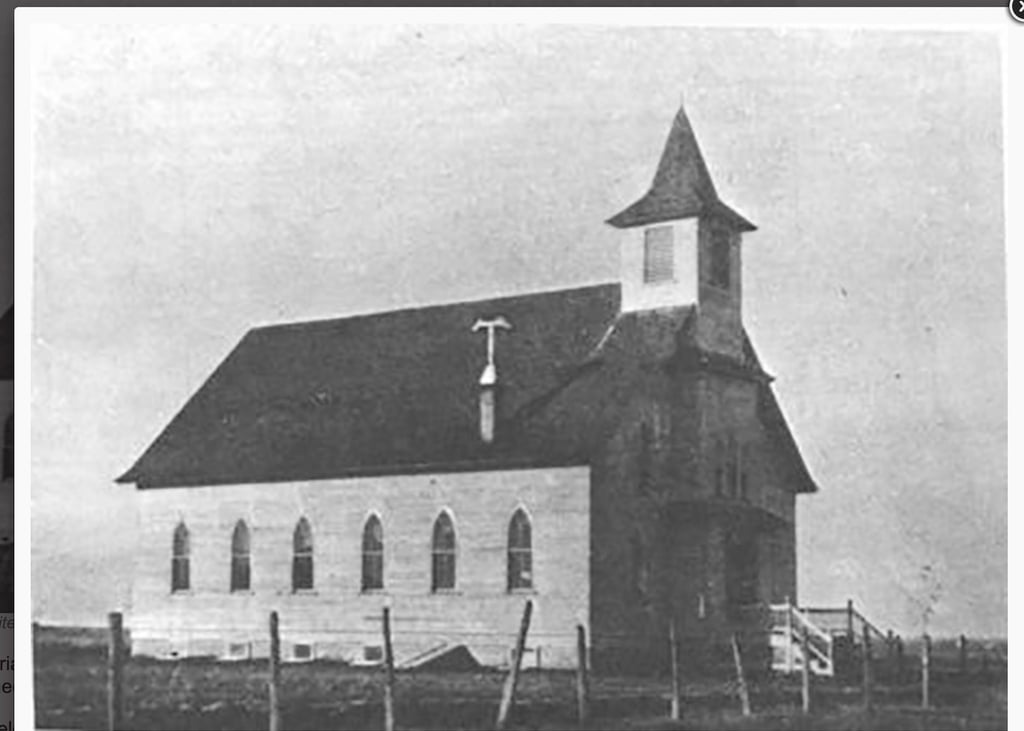
The Bingham County Mennonites first showed up in 1905, some buying land from an unscrupulous broker that hadn't yet been released by the State. The next year they discovered, according to George Bartel's account, that American Falls Canal officials—probably Frederick Sweet, credited with founding Aberdeen—had filed for the land they were working. The Mennonites found ground elsewhere, out in the drylands. Five families came from San Marcos California and nine from Paso Robles in the late 1900s, the remainder moving in from the Midwest. Thirty-six charter members comprised the new Mennonite congregation in 1907 and built a church three years later.
Just as the Mennonites had maintained a cloistered community in Russia and in their U.S. enclaves, the local variant kept its people close—most still spoke German at home, only picking up a few words of English though their children went to English-speaking school and acquired a new language there. They discouraged young men from going to pool halls, and marrying outside the flock could result in excommunication, marriages still being arranged from within the group.
Some of the Mennonite families, even after a century in the U.S., still didn't speak English, and those further out in the desert soon formed their own Church, located six miles southwest of Aberdeen, around 1912—in part due to convenience, the four miles to the other church being a significant trek with a horse and buggy, but also because the Mennonite Church in Aberdeen, in a 1911 decision, okayed an English Sunday School to begin. That school, though apart from the Church itself with separate administration, represented the outside world to the more fervid Mennonites. The Aberdeen Church, to appease the disgruntled, added that all services would be continued in German but that capitulation didn't suffice for the stauncher Mennonites further from town. They clung to their language, would continue to record church minutes in German until 1930. The Aberdeen Church would record in English starting in March of 1918, pressured at the time by the American Legion and local Council of Defense to drop the German language.
A number of Aberdeen Church members of position resigned when the rift occurred and joined with the newly formed Emanuel Church—sometimes called the Homestead Church. It would be almost two decades before the two factions rejoined. Among the differences: women were never involved in the running of the Homestead Church, but began working with the Mennonite men at Aberdeen as early as 1916.
Aberdeen and American Falls weren't the only German enclaves. A number of Mennonites clustered at Dubois for about seven years, some of them later reflecting on their years there as their happiest times—until the drought hit. Fifty-one couples and thirteen single Mennonites resided there from 1913-1920—a total population of 226, a significant number.
Mennonites flocked to Minidoka, too, some joining the Homestead Church, the break-off from the Aberdeen church, which formed as a more convenient place having attitudes more attuned to their liking—German-speaking, in particular. Taber drew German dry farmers, as well, with ten showing up in June of 1913 and another six from Illinois later that year, in August. Ten more German families were expected there in April of 1916. A year later, war would be declared against Germany.
A day after Woodrow Wilson asked for a joint Congressional Resolution to enter the war and a day before the U.S. Senate passed it, anti-German sentiment reared its head in Blackfoot. A group of a hundred men, led by Mayor E.T. Peck and lawman Charles Thompson, took the Mackay Branch train to Taber, eighteen miles northwest of Blackfoot, far out into the desert. Supposedly, the Germans there had raised their country's flag and needed reprimanded. The quickly formed 'committee' found no flag and, after compelling the citizens to raise an American flag at the schoolhouse, nailing other flags on residences and businesses and offering some stern advice, returned home.
Elsewhere in the area, the anti-German fervor simmered, too. In Pocatello, canal breaks suggested—to the more conspiracy-oriented—sabotage by German sympahizers, with the Farmers Protective Irrigation Association asking the Governor to step in and warn all parties to stay away from headgates and dams. In Pingree, a perhaps less-than-well-meaning community patriarch visited the German blacksmith, a Mr. Hennebold, and suggested he put up an American flag—needless to say, the advice was unappreciated.
The Mennonites' pacifist stance—a longtime tenet of the faith, coupled with their insistence on German speaking, aroused suspicion and anger in the community. American Legion representatives visited both Aberdeen churches, in less-than-friendly encounters, to insist the congregations not use German in worship or on the streets. Aberdeen's Reverend Elmer Neuenschwander, who began serving the Church in 1914, was threatened with tarring and feathering, despite the war being over, and he left his post and the area immediately. Fellow Mennonite John Toevs wrote to Senator Borah to complain about the matter, and though Borah was sympathetic about their right to use the German language, it would be best to conduct matters in English.
The Mennonites resolved at the time to print their Constitution in both English and German. Membership of the Homestead Church was dwindling with the failure of dry farming, its peak of 134 worshippers in 1921 (17 of those from Minidoka) dropping to 59 (11 in Minidoka) on January 1, 1924. At the other Church, changes were coming, too. By 1924, German speaking services there were just on the first Sunday of each month, a practice abandoned fully by 1929. In 1926, so few members were at the Homestead that the Aberdeen Church adopted a resolution for the two factions to join, but it met with a lukewarm reception Still, the two churches' membership, together, administered the Bethany Hospital in American Falls into the mid-1930s.
In 1930, the Homestead finally voted to disband and to sell the Church building. An offer from the Grandview LDS Ward to purchase it was accepted but no money came forth, so the building was dismantled and its lumber used for an addition to the Aberdeen church. Disgruntlement continued, however, with some members attending the German Baptist Church and others the German Congregational Church elsewhere in town.
Active combat in World War One ended on November 11, 1918, though a treaty wouldn't be signed until June 28 of the next year. But the anti-German activity continued—the human instinct to persecute, once awakened, is hard to quell. The Aberdeen American Legion, in late February of 1920, adopted a resolution against the use of the German language. The Blackfoot post soon went on record, in a "rousing meeting," in unanimous support of the Aberdeen action. Joseph Menlitz, a Mennonite man, wrote to Blackfoot's newspaper, The Idaho Republican, eloquently responding: "There are many of the older...men and women who never had an opportunity to study English and who are now too old to study the language." He compared the American Legion attitude to that of the Prussians, as applied by the Germans to Poland and Alsace-Lorraine. "Trotsky spoke English fluently," he noted, but was no American at heart. "You allow the Mexican to speak Spanish, the Austrian to speak Slavish, the da-go Italian, but it is a crime for the German to speak German." Let the older people speak German, he wrote, and our children "are all studying English...we hope to see them become good American citizens.