"Braskie" Mellick's Rise and Decline
An early Bingham County cattleman goes berserk
7/21/20263 min read
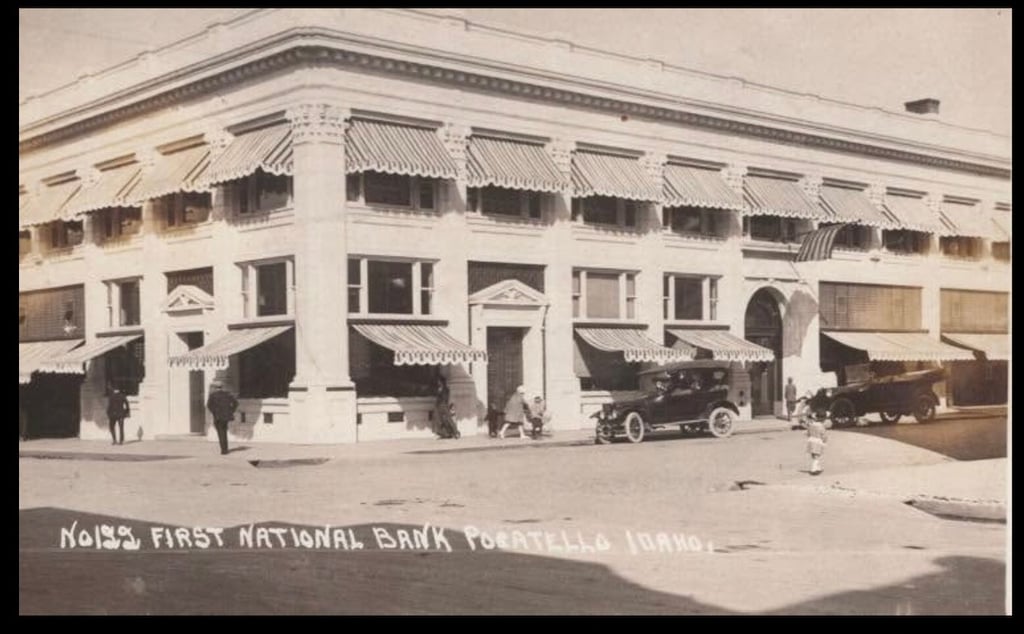
A later version of the First National in Pocatello
One little known cattleman from the Eastern Idaho range era before the turn of the turn of the century was W.F. "Braskie" Mellick, who rose to prominence in the latter 1880s and 1890s—before his fortunes turned sour and he wound up in a New Jersey asylum after a crazed binge in Chicago. Mellick served as President of the First National Bank in Pocatello around 1890, had been running cattle for some years and earned the name—which others seemed to share—as the Snake River Cattle King.
Mellick purchased Fort Hall Reservation's Ross Fork store from Bible, Brown and Johnson in 1888, and soon had the contract to provide both the Lemhi Reservation and Fort Hall Reservation with beef, the two contracts totaling over 1.5 million pounds at 3.5 cents a pound—it would take 18,000 cows, it was estimated, to fill those contracts. He served as a director of the Idaho Stock Association, which included recognized names like Thomas Sparks (a Nevada based interest), William Burke, Nels Just and Thomas Keogh. He intended to build a $15,000 brick hotel in Pocatello in 1892, about the same time Reynolds and Lonergan (a Wyoming interest that spread from Nebraska and into Utah) was purchasing cattle for him. His crew was driving 20,000 head to Montana in 1894 to graze, having spent $85,000 to purchase them (3.3. million, adjusted to the present). A local paper described him as single, "young and handsome" and advised girls to "set their caps" for the large cattle owner.
Bilious McDaniels, a local name of color for the last quarter century of the 1800s in Bingham County, foremaned for Mellick at one time or another, as did Frank Hubbs, who drove Mellick's cattle to Montana. There was a plan for Hubbs to drive Mellick's 20,000 head all the way to Alaska in 1897 to take advantage of the Yukon Gold Rush and the outrageously high beef prices. It was a journey Hubbs estimated would take two years over mountains, rivers and snow fields. They were selecting 400 of the biggest steers to use as 'leaders' for the herd, intending to halter and yoke break them. The crew needed for the drive included "cooks, blacksmiths, drovers, forty women, a number of sailors, bridge and raft builders." "If pressed for forage," Hubbs said of the ponies to be used on the drive, "they will be made to eat fresh beef" and made to graze "on the back of the long-haired animals that will grow moss and grass in the rainy season." Given there is no more record of that drive, one might assumed it never actually transpired.
Mellick's career came to an infamous end in 1900 at a Chicago hotel, where he went into the dining room and ordered a very expensive breakfast (some reports say $200, about $8000 adjusted to today's money, some reports say $1000), then became violent when his request wasn't honored. Police subdued him despite his claims of being worth two million dollars. He was transported to a New Jersey Asylum and his Montana acquaintances were being notified of his condition. His father, a wealthy landowner in New Germantown, New Jersey, signed off on Braskie''s commitment.
His son's story filled out this way: he had been in Chicago for a number of days after selling his cattle there, went with a large roll of bills to the theatre, staggered to his hotel where he had to ask to borrow two dollars for his taxi ride there. The cab driver said he found Braskie near the Lincoln Park boulevard, dazed, his money, watch, rings and other valuables all missing. The next morning he drew a check for one million dollars and ordered a thousand dollar banquet to be served by one hundred waiters, soon after which a physician and a policeman were called. Montanans were not surprised by Mellick's turn of sanity, having described his pre-Chicago behavior as being "queerly" due to a recent reversal in fortune.
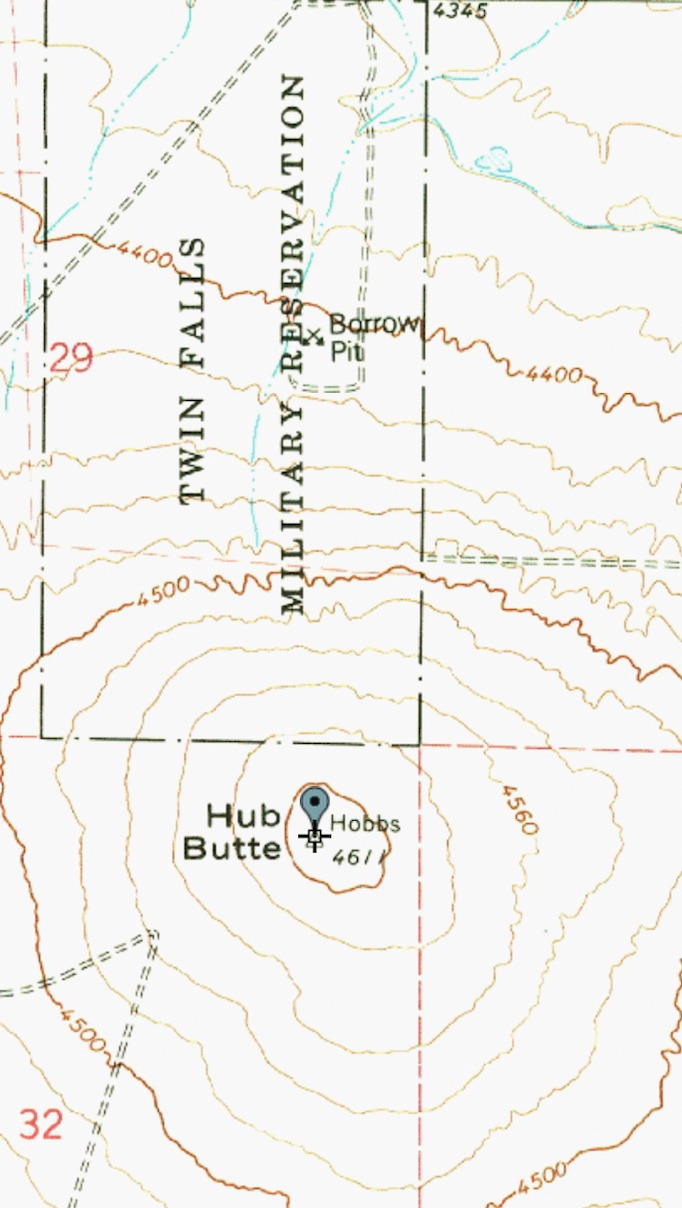
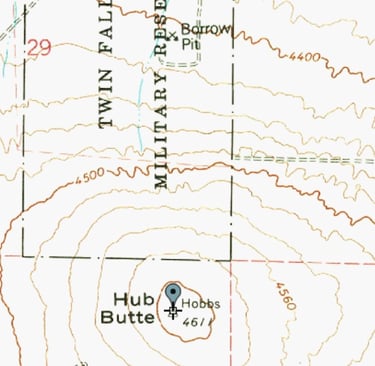
Hubbs, Mellick's right hand man, was a congenial man whose name graces a 4606' peak ten miles south of Twin Falls, Hubbs Butte (sometimes called Hub Butte, seen in picture below). Hubbs had proved up on a field nearby in 1885, was doing well with cattle until the "Big Die Up" in the mid 1880s and a winter nearly as bad a couple years later. He reflected that the spring after one of the winters he had barely enough hides to "make me a pair of boots." He retained his respect and little else, was trusted to carry his bosses' bankrolls to the bank and was never known to "spend a cent irregularly." He worked for Sparks-Harrell in Nevada as well as Mellick and, according to a 1924 report from Roughie Howell (another well-known Bingham County cowboy who was working for Harry Hamilton) would recapture some of his fortune in California, where he, at seventy-three years old, ran cattle south of Fresno at a place called Springville.