HERMITS IN THE DESERT
Recluses' homes in the desert near Rock Creek
4/27/20263 min read
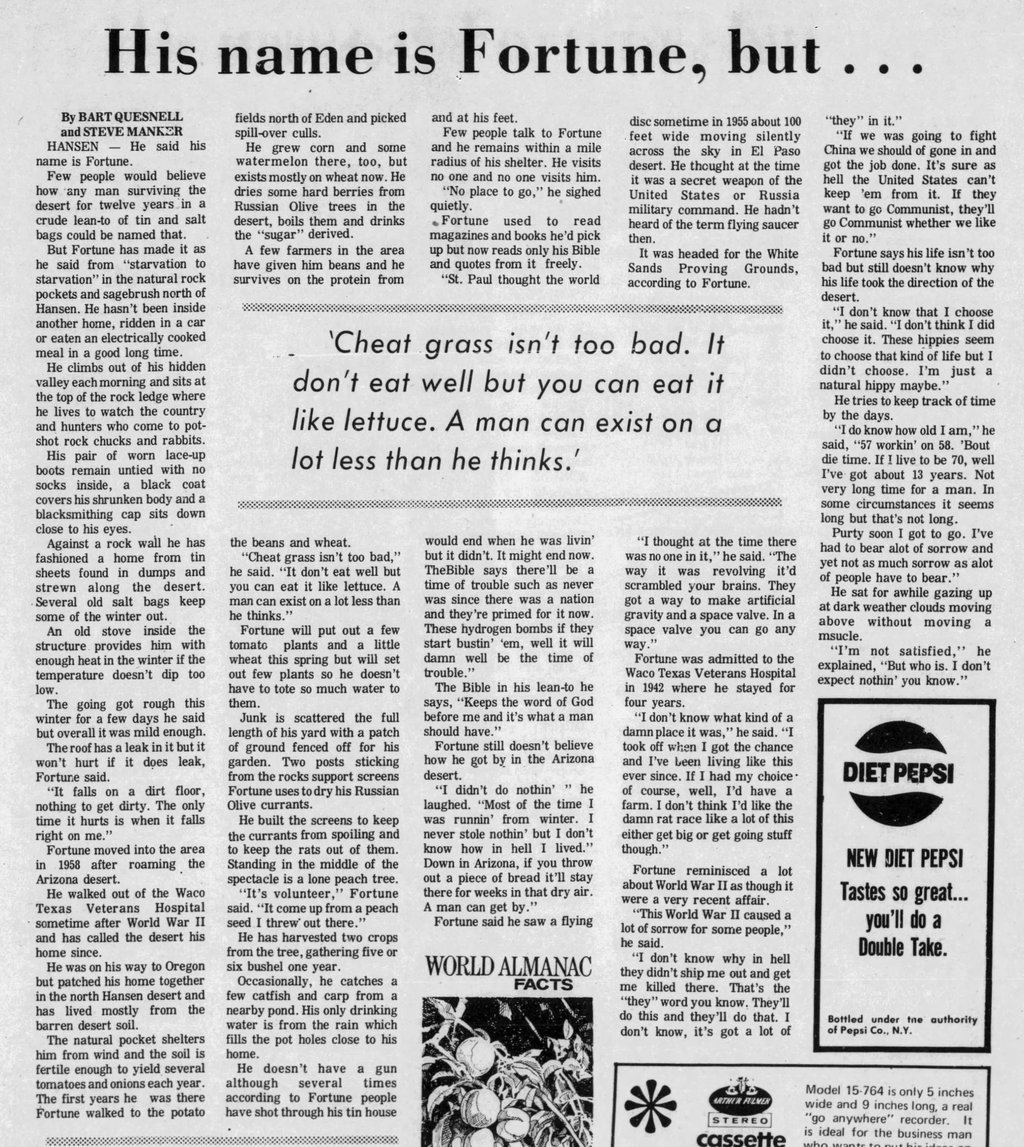
"Cheat grass isn't too bad...you can eat it like lettuce," So said the Twin Falls area hermit called 'Fortune' in 1973. He'd been living in the rock pockets and sagebrush north of Hansen for twelve years in a lean-to made from salvaged tin and salt bags. The reporter who interviewed him noted he wore untied lace-up boots with no socks, a black coat covering his shrunken body. His roof was leaky, but didn't hurt anything because the floor was dirt, and a makeshift stove took to chill off the worst nights.
He had come to the area in 1958 after roaming the Arizona desert for years, that after walking out of the Waco Veterans' Hospital sometime after WWII. He grew a few tomatoes and onions, salvaged cull spuds from the fields within walking distance, had grown watermelons and corn but subsisted 'mostly on wheat'. He boiled Russian Olive berries to drink the 'sugary' water they left. He also ate cheat grass. "A man can exist on a lot less than he thinks," he said.
A peach tree had grown from a discarded seed he'd thrown out and he harvested a crop from it and from time to time he caught a fish or two from a pond near enough to walk to. He once read magazines, he said, but now read only his Bible. When he was in Arizona, he witnessed a UFO and had his theories on its origin. "They got a way to make artificial gravity and a space valve," he said. He didn't think he chose this life, he said, not like the hippies who did. "I'm just a natural hippy, I guess," he said.
He thought he was 58 years old and figured he had a dozen years left. "I'm not satisfied," he said,"But who is?"
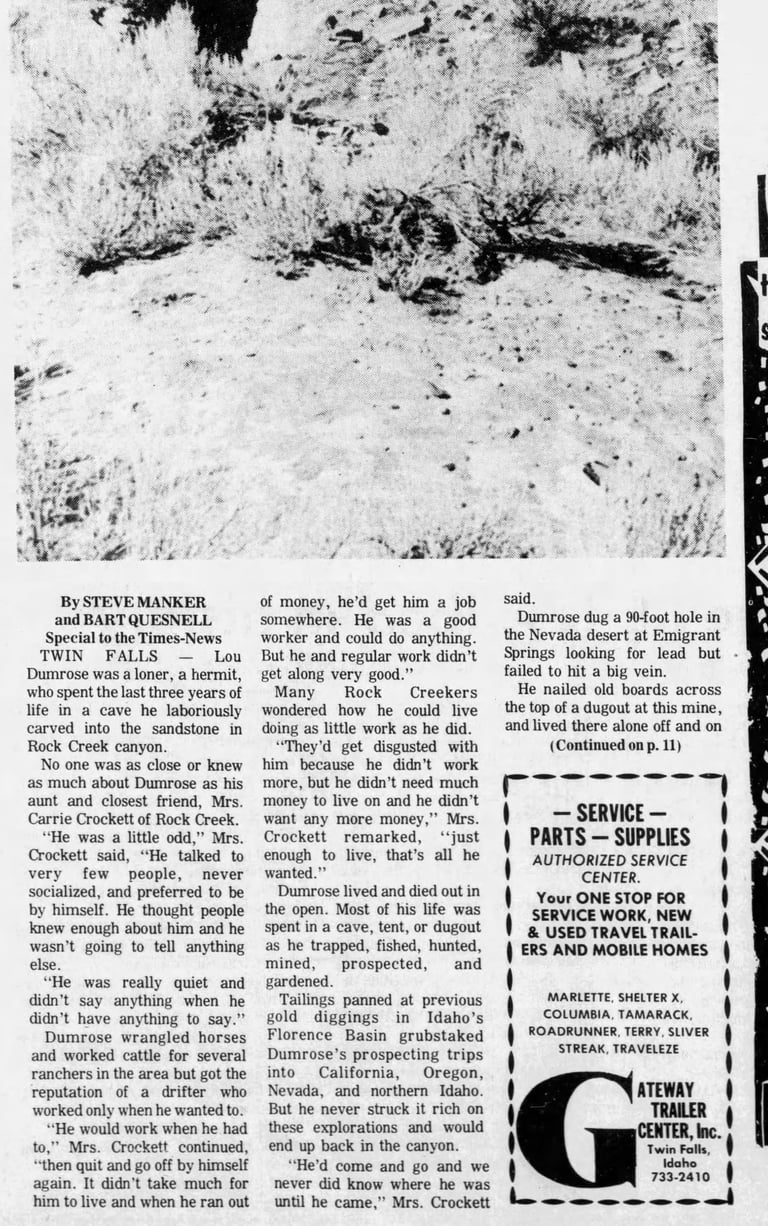
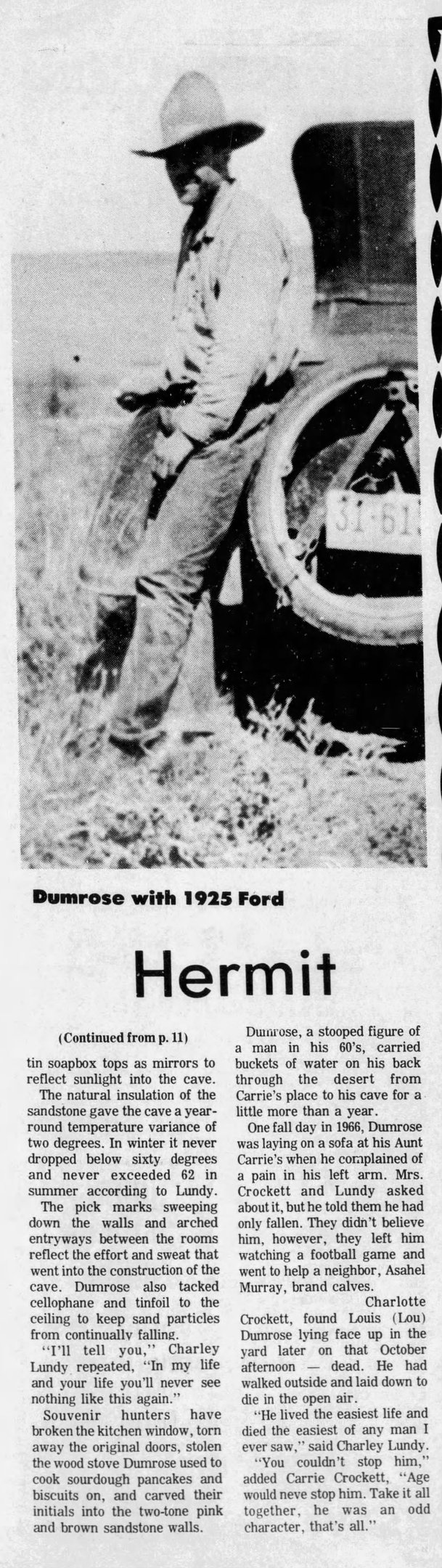
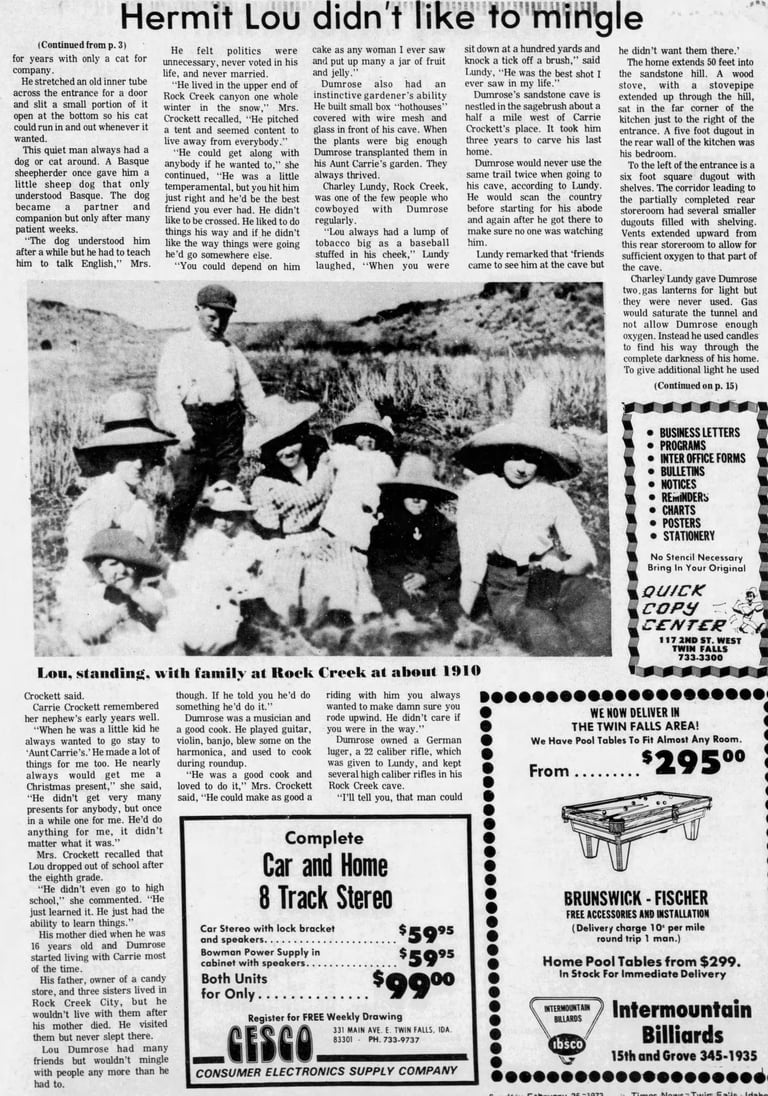
A second hermit who lived ot far from Fortune had died some years earlier, before Tortue was interviewed. Lou Dumrose had carved a cave in the sandstone and spent three years living there. His aunt, Carrie Crockett at Rock Creek, helped him through hard times with little bits of assistance. He wrangled horses and worked cattle but didn't keep a job, work schedules not being of his interest. "He was a good worker and could do anything," she said, just didn't want to be tied down. He had been panning gold in Idaho's Florence Basin, without luck, had made similar prospecting forays into California, Nevada, Oregon and Northern Idaho that yielded like results. He had dug a ninety foot hole at Nevada's Emigrant Springs without any ore find but he nailed boards over the top of it and lived inside for years, only a cat for company. He sliced an innertube to make a cat door in the boards so it could come and go as it pleased.
Lou had a dog for a while, given to him by a Basque sheepherder. "It only spoke Basque," so it took him awhile to develop a relationship with it. According to his aunt, he dropped out of school in the eighth grade. When his mother died he went to live with her, though he visited his father, who owned a candy store in Rock Creek City, and his three sisters. He had never voted, never married, was a musician who played several instruments and occasionally served as camp cook for cattlemen. He chewed such a big wad of tobacco that a fellow rider said "you always wanted to make sure you rode upwind of him." He owned several guns and could "knock a tick off a sagebrush" at one hundred yards, according to the same cowboy.
It took him three years to carve out his cave, which went fifty feet into a sandstone hill, in the desert. A stovepipe ran from the cave through the hill to the outside, there were shelves and a bedroom, and a storeroom.
He had a makeshift "solar energy setup", using box tins to reflect the sunlight outside into the cave, where the temperature stayed around sixty degrees year-round. Dumrose, in his sixties, carried water in buckets to the cave. He died at sixty-six on his aunt's couch and by the time of the above article's appearance vandals had wrecked his cave, breaking its window, tearing off its doors and carving their names in the walls.