James McTucker
One of the first white residents of the Blackfoot area.
7/8/20263 min read
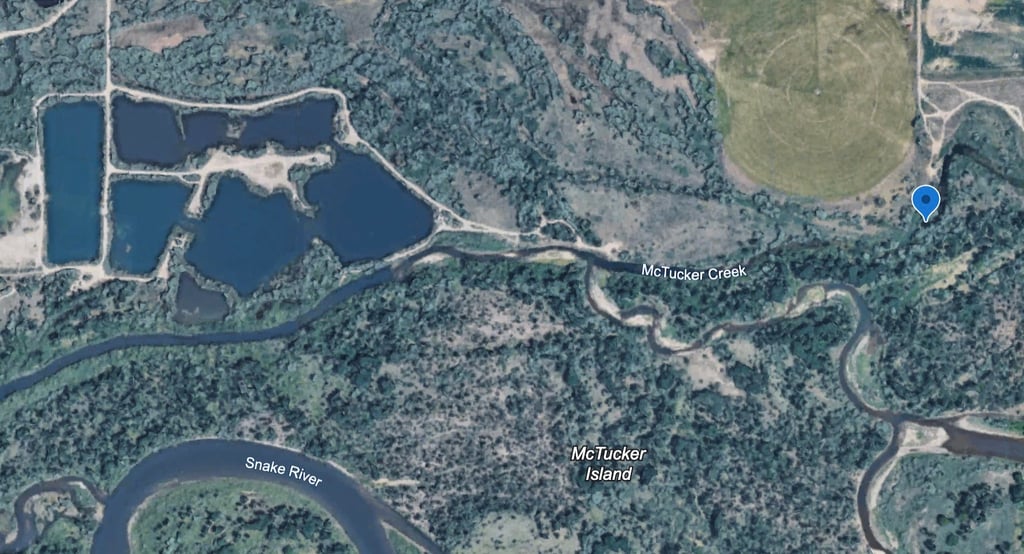
The Google Map attached shows the McTucker Springs area. On the upper left, McTucker Pond fishing and camp area. The bottom half depicts McTucker Island—only an island during extremely high water. The blue 'pin' designates the location of an old homestead that might conceivably be James McTucker's from the 1870s, though that is pure conjecture—Joseph Hansen laid claim to the same land in 1904, the Coumerilhs owned it somewhat later, and Alva Belville owned it after that (Chandlers took over from Belville). Here's the story about McTucker printed in the Idaho State Journal in 1950 and written by T.G. Bond:
His name was James McTucker. The Indians called him “Patsegora” or Bald Head.” McTucker was one of the greatest characters produced by the State of Idaho; an orphan at eight years. At ten years he walked twelve miles to hear Douglas and Lincoln debate. As a boy I used to sit in McTucker’s room back of the butcher shop and listen to his storiesof the gold days, the scouts and Indian fighters. He always tried to impress upon me the sacred principles of our country’s government. Ofttimes he’d stand by his little table and deliver Doughas’s flowery speech in his debate with Lincoln, then sit down and scratch his chin and fix his beady eyes on every movement, every word, as Lincoln would rise in rebuttal. Then McTucker would deliver Lincoln’s speech in all its majesty and simplicity with his long forefinger pointing out the everlasting truths of our government - “a house divided against itself cannot stand” - the only gesture Lincoln ever used. He went West with the gold rush to California as a young boy. For a number of years he ran a dairy, supplying milk to the miners. Later, moving to Idaho, re ran a ferry boat at the Ferry Butte (this may have been near 'Cable Hole', straight south of Pingree on the river—in the 1970s, according to rafters, you could still see the cable from the Ferry that was located there). His ranch was nea where we called the spring on his ranch “McTucker’s spring.” He laid out the wagon road from Blackfoot to Lost River. He founded the Blackfoot school, and was president of the school board for many years. Having no family, he adopted all the children in town. Times were hard, but no child missed his chance to go to school because of lack of books, shoes or clothes. No man or animal left his door without being fed. He had a horse and cart for use in his shop. For twenty-five years he carried all who died, rich or poor, in the cemetery in his cart, never charging a penny, always sitting outside in the cart. He never entered a church, yet he lived between two saloons and never entered a saloon. He kept a little room back of his shop, with chairs and papers and a barrel of water, always full, and a cup hanging near. Always said “drink it while you are young.” His knowledge of history and the country’s government was profound. His opinion on a political issue was the last word. McTucker’s butcher shop and its credit was the rock upon which the early settlers leaned. The Indians were never denied credit, and a word from Mack settled disputes between Whites and Indians. We had peace at all times. The sorrel horse that pulled the cart on its daily rounds was like its master, getting old. One morning it wouldn’t eat; by noon it couldn’t rise to its feet; beat its head on the ground. For McTucker the sun seemed to set. They had grown old together. Sitting in his chair, never eating or sleeping, McTucker waited and hoped. Two men were hired at three dollars a day, when a dollar was hard to get. For three days they stood at the horse’s side, night and day, doing all in their power to make the passing of the horse as easy as possible. When the end came, a grave was properly dug, the horse placed carefully in it, then McTucker sent everyone away. McTucker was left alone with his friend in its last rites. After this, the old man seemed to fade. His spirit wandered far away. I held his hand in the early evening one day as the sun was setting. He roused from a little sleep, and said, “read me the headlines in the paper.” I did. He wished me goodnight, and said, “the teams and wagon are ready, we’ll start on a long trip early in the morning, and camp on the first feed and water.” The teams and wagons were ready. But Mac didn’t make the trip he planned. Instead, we gave him his last ride. But all of us have missed him throughout the years.