TARRED AND FEATHERED IN BINGHAM COUNTY?
Rumors and threats during WWI in Bingham County
3/23/20265 min read
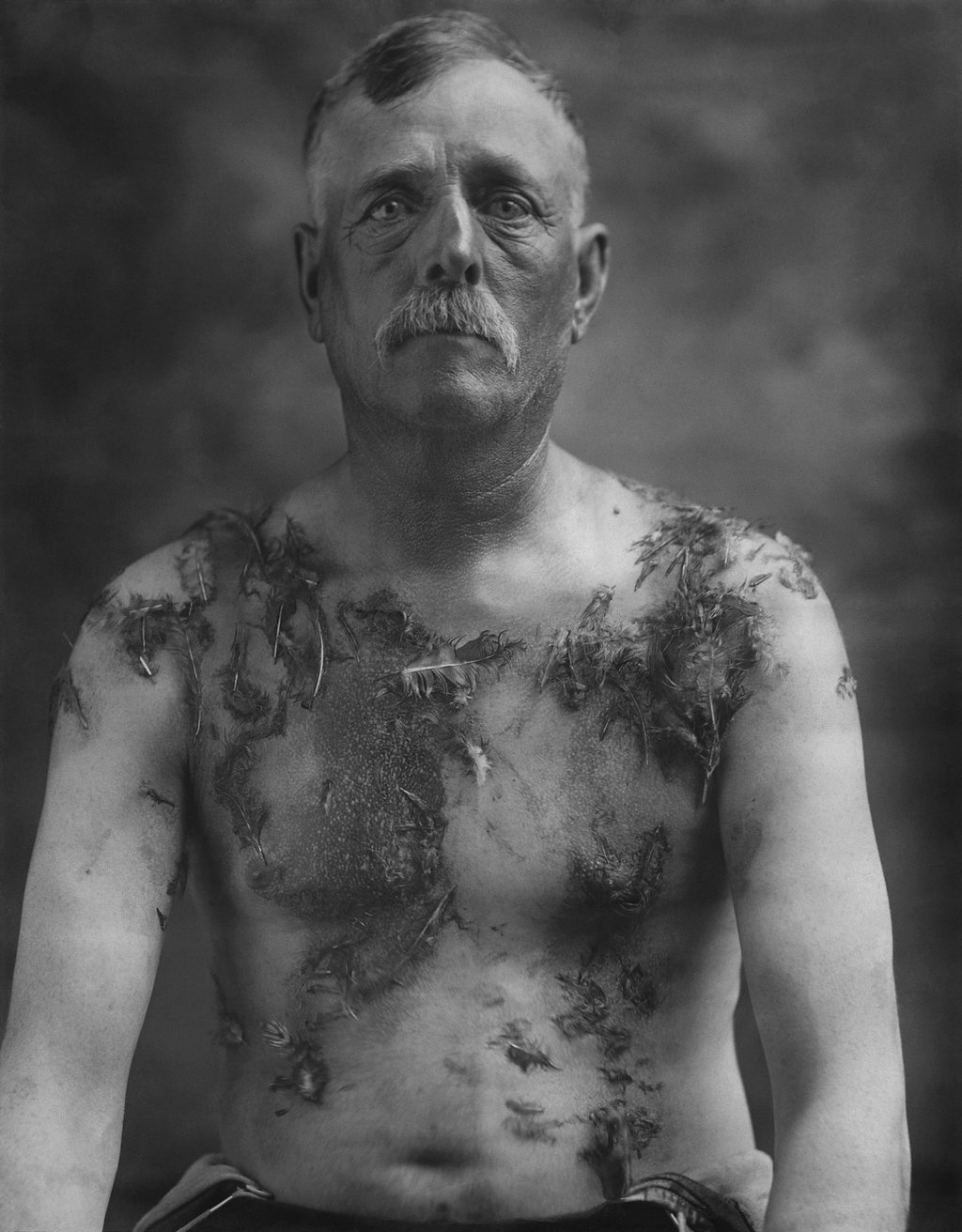
Photo: Wikimedia Commons, Minnesota man tarred and feathered during WWI
For a brief time coinciding with WWI, Bingham County experienced (at least in rumor) a spate of vigilante justice that included the medieval punishment of tarring and feathering. Maybe the local men read the papers to get the idea—southerners were tarring and feathering black men in the South at the time, midwesterners were tarring and feathering socialists and International Workers of the World proponents, and in Ireland the Irish, seeking their own country's independence, were tarring and feathering English sympathizers.
The vigilantism appeared most prominently—or perhaps, most publicly—in the Pingree-Aberdeen area. According to one of his descendants, Wilbert Atwood, who filed for his homestead a mile northwest of Pingree in 1914, was tarred and feathered sometime in the years immediately following. He reported that 'the Italians' who had homesteaded nearby had it out for the few Mormons, of which he was one, 'intruding' in their area. Neither the accuser nor the accused being alive, the story cannot be substantiated, though there were a number of Italians in the area then, some of them having filed on land when the Aberdeen-Springfield Canal was first built with the promise of irrigating the land north of Pingree. That acreage being at a higher elevation, however, the main canal couldn't reach it, so it was another decade before the pumping station built south of Rockford could supply water to the area. Water disputes being common, the tarring and feathering, if it indeed happened, may have been instigated by a conflict of irrigation rather than ethnic differences. As for there being only a few LDS in the area, that is disputable. Though Presbyterians had meetings in Pingree and Springfield at the time and the Italians were of a Catholic persuasion, LDS settlers were aplenty if not yet a majority of the population.
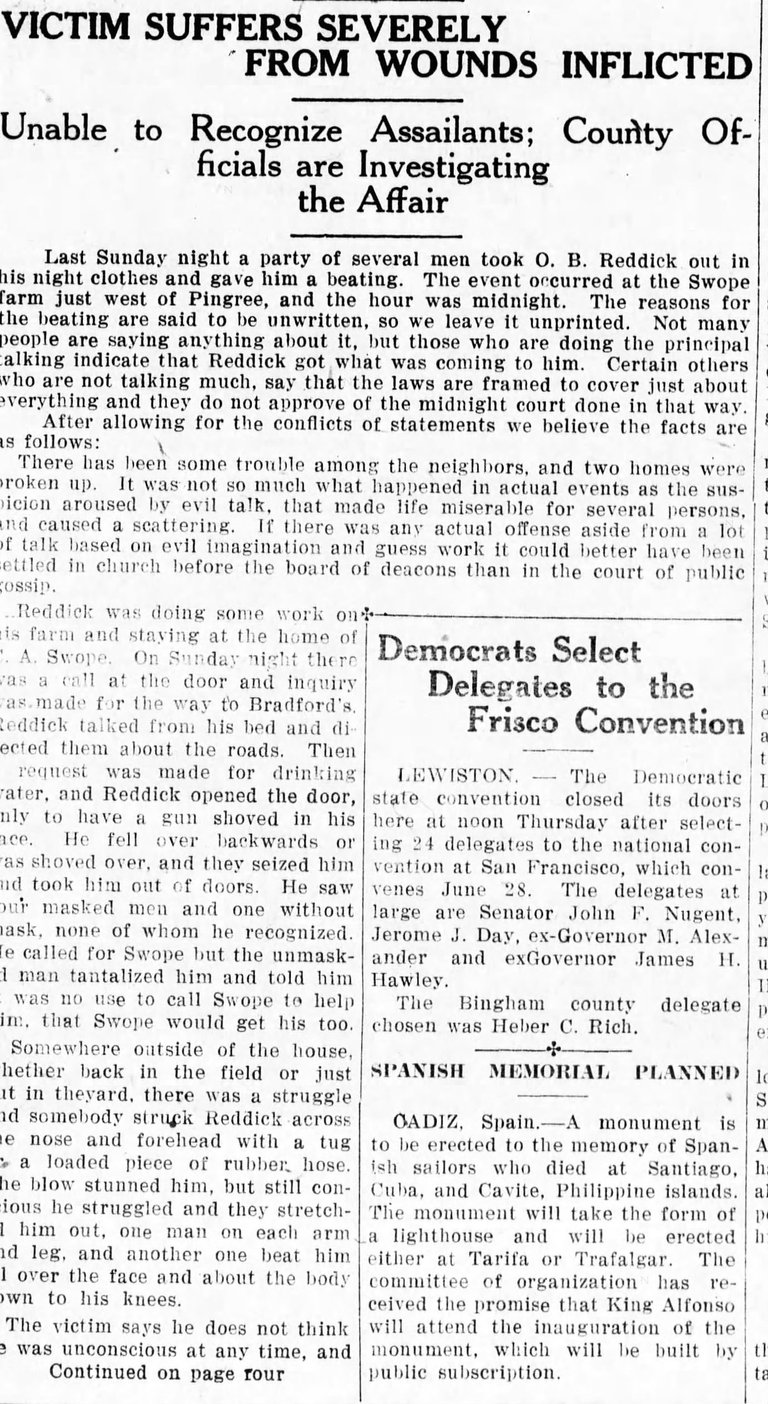
About the same time as Atwood's run-in another rumored Pingree tar-and-feathering occurred when settler (and former teacher at various local schools) O.B. Reddick purportedly took a severe beating from a gang of masked men. Though newspaper reports didn't include any tarring or feathering, as rumors indicated afterwards for years, Reddick did nearly lose an eye and suffered considerable injuries.
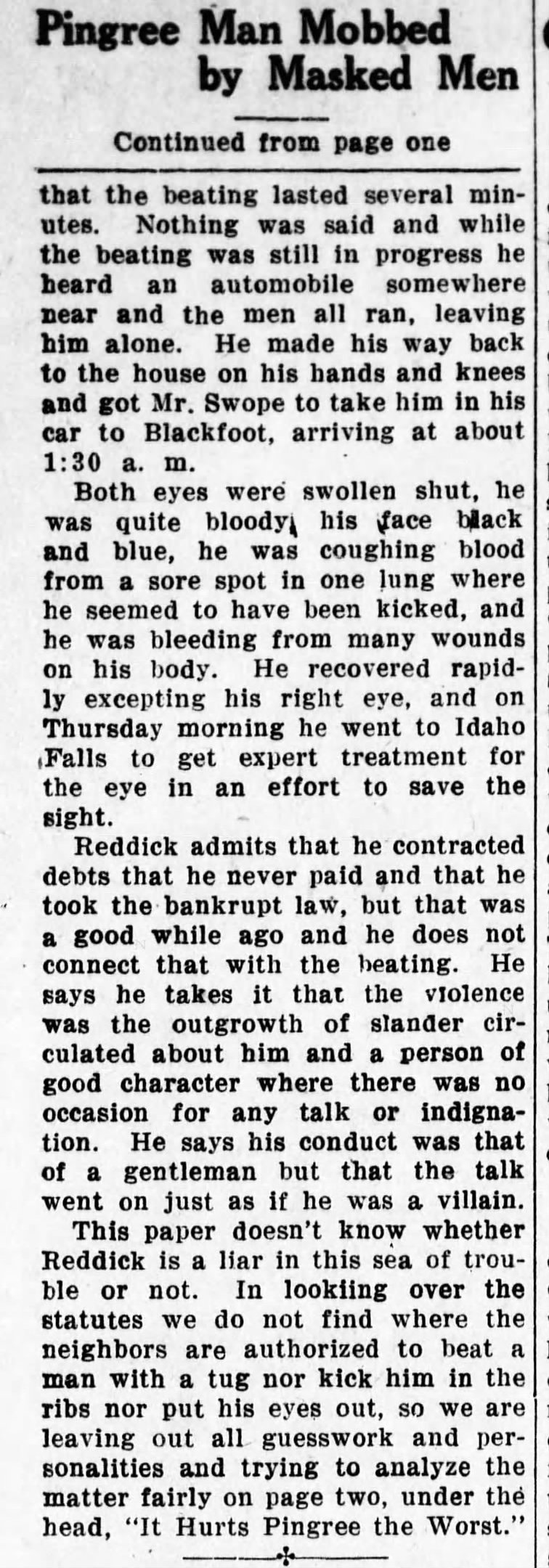
Reddick had a considerable homestead of 160 acres south of Pingree at the time and was staying at fellow Kansan C.A. Swopes', the former Pingree store owner, who was proving up on a plot of land just west of the village. On a Sunday night Reddick was awakened at midnight by men asking where a neighbor's property was and from his bed he shouted to them the directions. They then asked for drinking water and when he answered the door he was met with a gun in his face. By his account five men, four of them masked, dragged him outside and beat him on the body, limbs and face for several minutes. Other reports said there were as many as 35 men involved. An automobile driven by Swopes came and the men ran. Swopes then took Reddick to the hospital. His eyes were swollen shut, he was coughing blood, and he had numerous cuts and contusions. He went to Idaho Falls to a specialist the next day, hoping to save his right eye.
The local paper excoriated the community, suggesting that half of the men in the fifty to a hundred families in the area may have participated in the vigilante justice without knowledge of fact and without possession of lawful authority. The paper noted that while Reddick had many unpaid debts accrued over the last two decades and had a significant following that he led in opposition to road bonds at an earlier date, the beating was unjustified. The assault was, however, by all accounts, not due to monetary mishandling but to Reddick's rumored extramarital activity which gossip claimed tore apart two families.
The woman supposedly at the cause of the beating wrote the paper shortly after the incident to clarify that Reddick had always acted gentlemanly toward her and wasn't responsible for the breakup of her marriage. She explained that she and her husband had been fighting for years when they lived in Pingree and she had long vowed that once the kids were grown she would leave the area, which she did. The Pingree people, she wrote, had been insinuating wrongdoing between her and Reddick for some time and she had written them in the past trying to exonerate herself and Reddick.
Reddick and his brother, originally from Kansas, had made their small mark in the area, r Fred teaching at Thomas and Rich (what is now the Tilden Bridge area), before becoming the principal of the Thomas School in 1907. O.B. taught at Arco before he and his wife, who was the daughter of a prominent Kansas attorney, began teaching under Fred's supervision at Thomas. Shortly after, they moved into the fish hatchery house south of Springfield and he taught school a mile away at Tilden, just above the hatchery creek that flows onto the flats (the foundation of that school still remains). He and his brother Fred weren't just scholastically inclined—they may hold the Bingham County record for biggest acreage under onion production, their holdings for that crop reaching six acres in 1908.
O.B.'s wife, not to be outdone by her husband's accomplishments, dabbled in the fine arts, sending artwork to Seattle for exhibit and writing a play, "The Ten Virgins." Its only performance may have taken place at the Springfield Presbyterian 'tabernacle' in 1909 though she intended to place it with a publishing house.
O.B. was instrumental in Pingree's development, petitioning for a Post Office—gathering 44 signatures in thirty minutes—in 1909. He became president of the Pingree Commercial Club at that time. Fred moved into the townsite and sold his belongings from his land at Rich, which included 35 hives of bees and 21 horses, at a Pingree auction, where a meal at the Pingree Hotel was being served for attendees for twenty five cents. The Pingree train would be held until 5 PM, attendees were told, to make sure prospective purchasers could get home to Blackfoot. Fred went back to Pleasanton, Kansas shortly afterward.
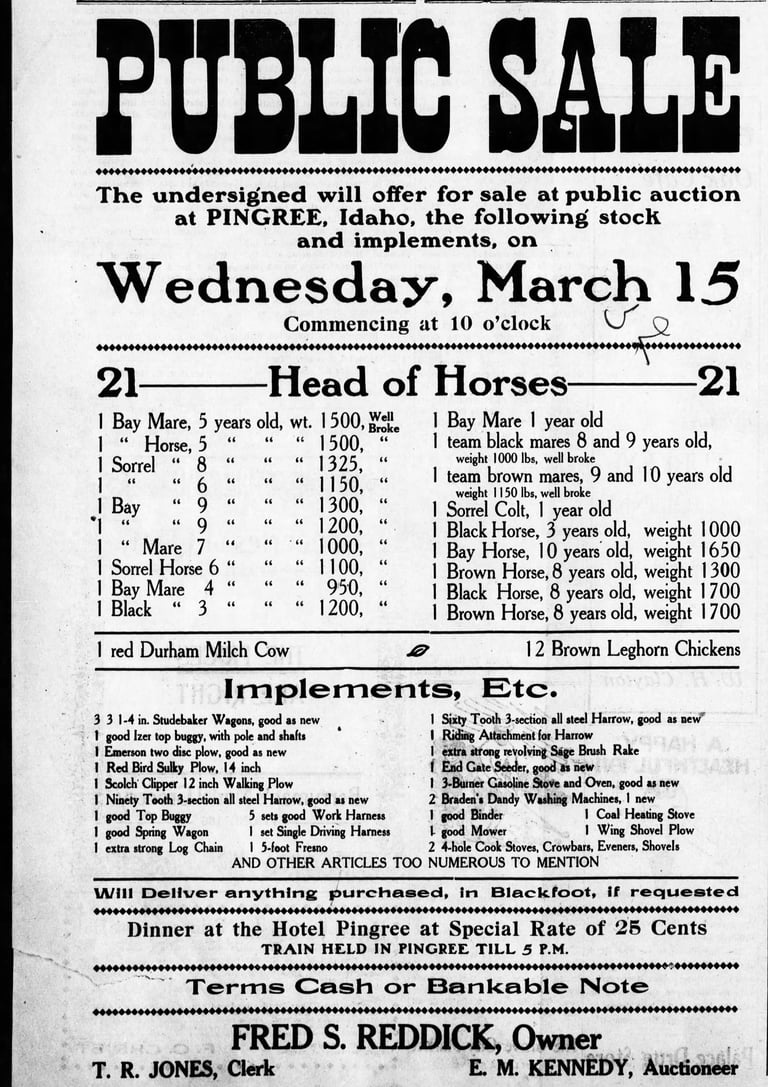
Not long after being assaulted (and tarred-and-feathered, according to local lore), O.B. Reddick sold off 84 acres to the Pingree blacksmith, German=born J.W. Hennebold, in 1922 and left the area, first to work at Bistline Implement in Blackfoot and then returning to Kansas to teach by 1934.
Those rumored incidents were matched by a more credible account of a threatened tar-and-feathering at Aberdeen. During the first World War, at the Aberdeen Mennonite Church—a predominantly German speaking congregation—Reverend Neuenschwander was preaching when four men entered the church and stood in the doorway. Invited in, they sat until he closed the service (quite likely, he was delivering it in the German language). Some weeks or months later, the men threatened to tar and feather him if he didn't stop, and after the threats worsened he resigned and left town. Such animosity hounded the Mennonites during the war years, just as it did other non-Mennonite Volga Germans in Taber.
If there were more roused mobs administering premature justice in Bingham County, their efforts never made the news.
Read the full account of Reddick's beating below: