THE DUTCH FLAT MENNONITES (DUBOIS AREA)
In the late 1910s, over 200 Mennonites briefly dry farmed near Dubois
3/3/20265 min read
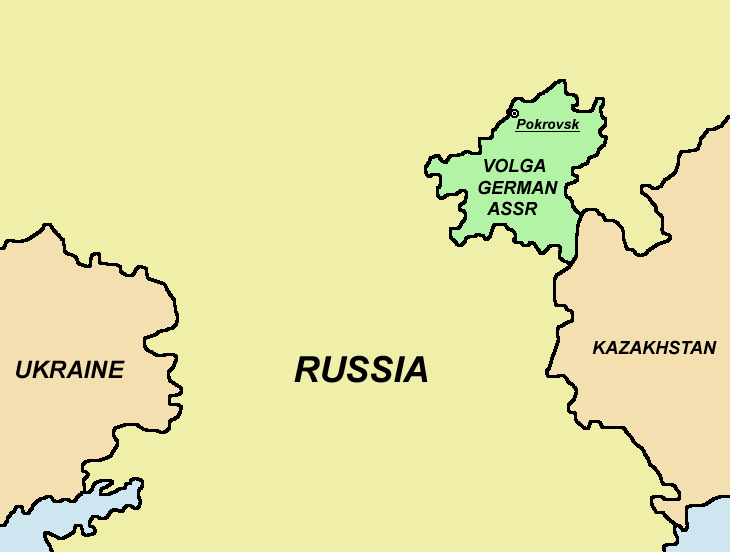
Above, a map of the general area from which the families of many of Idaho's Mennonites originated. The Volga Germans kept their culture and language, allowed to do so by a Russia that needed immigrants in the late eighteenth and nineteenth centuries.
Two hundred bushels of wheat from four hundred acres—not exactly a bumper crop, even by early nineteenth century dry farm standards when a fifteen bushel per acre yield might be considered a success. But that was the Isaaks' harvest in 1919. That drought year, a dry winter coupled with a dry, windy spring that blew out the seeded crops, was enough to force over 200 Mennonites to abandon their homesteads in the Dubois area. Some returned to Kansas and some went to Aberdeen, where another Mennonite community, if not thriving, was intact and promising. Their success was in part due to the nearby Aberdeen-Springfield Canal, extent for nearly a decade, which the Aberdeen Mennonites played a major role in building. The money earned from that work had been a boost to their fortunes.
That canal, and the water in it, drew Kansas Mennonites to Aberdeen, and similar promises of development lured a separate group of Mennonites to Dubois. Talk of a massive canal project that would steer through that area abounded. The State was withdrawing 1.4 million acres covering sixty townships from the public domain to be utilized under the Carey Irrigation Act. The notion of a canal diverting Snake River water from near the Chester area, passing by Dubois and Mud Lake, reaching even Howe before heading south to the Taber region before reaching the Snake again near American Falls, had been circulating since the mid 1890s and recent talk had heated up, Eastern developers that included those investing in the massive Twin Falls area water projects now interested.
Such rumor may have pushed the urge to move past the thinking stage into action. The family-oriented Mennonites had an extremely high birthrate—still reaching eight to ten children per woman as late as the 1990s—which entailed a need for more and more land for heirs who preferred farming to other occupations. Idaho provided that space, its aridity likely seemed no obstacle given they were already dry farming in the Midwest—they had, perhaps, no conception of just how little precipitation fell in Eastern Idaho. The promise of free land, given the rising prices in Kansas, tempted them to relocate, as did the possibility of a coming water water project.
In addition to the proposed Dubois enterprise, a smaller project close by fed into local talk. Preliminary drawings and surveys indicated that the Beaver Creek runoff would last until July and a reservoir could be built above Spencer for later season utilization—these rumors, like the Dubois project, never materialized.
Henry Lehrman's memoir describes his odyssey from Kansas to Dubois to Aberdeen. In March of 1914 he left the crowded Mennonite community in the midwest, taking farm machinery, three horses, and household articles in a freight car to Idaho—at a cost of $160. He noted he also had his Bible and his violin to keep him company.
He settled five miles south of Dubois, in a flatland area of about twenty square miles of which Mennonites would claim nearly three-quarters. Their prevalence inspired the area to be referred to as 'Dutch Flat.' He fenced his 160 acres—two miles of fence—built a barn, a rudimentary house, planned a cellar, and built a cistern—the stream that passed through his yard would only yield water into July, so he had to haul water from Dry Creek or Camas Creek, miles away. He supplemented his income by putting up hay for ranchers at Dubois and Medicine Lodge.
In late spring of 1915 Lehrman returned to Kansas to retrieve his bride. He helped harvest crops there and the couple then left for Idaho in August, departing the train at Jones, a nearby flag station—a designated spot where settlers could flag the train down to stop and pick them up. It was just three miles from their homestead whereas Dubois was five miles.
wo days by train to county seat in St. Anthony. for some wages put up hay at Dubois and Medicine Lodge.
The Lehrmans cleared land with a sixteen foot rail, gathered the grubbed-out brush and burned it, the women helping with that task. They burned sagebrush for fuel in a four hole cookstove—it almost kept a fireman busy, Lehrman wrote, feeding it on a cold winter day. To supplement the brush, they collected coal that had spilled from railroad cars.
The Lehrmans' first harvest ran into a snag, the steam threshing unit crew that worked the area operating on Sundays—contrary to Mennonite beliefs. A local rancher rescued them, offered a 'fixable' thresher from his farm, which they reconditioned and used ten horses to operate for their harvest. In subsequent years, the traveling threshers did the work, not mentioning Sundays as a working day.
The Mennonites organized a school in 1914. It took a two day rail trip to the county seat in St. Anthony to complete that bureaucratic process. For Church service, a minister from Aberdeen or Colfax, Washington came to conduct services twice a month, with layman reading sermons the other Sundays. The community built own telephone system, a party line not connected to the Dubois Central, using the existing barbed wire fences for the signal, connecting where needed and raising the wire above roads so wagons could pass underneath. The telephone committee authorized twenty-five dollars for expenditures to create the system, and would later pay a lineman thirty cents an hour to make repairs. Mennonite Henry Brandt's house served as the connection point for phone calls, a bell ringing when someone wished to call, Henry then connecting the desired call recipient to the caller.
The Lehrmans needed more land to make dry farming work, so rented another farm eight miles from them. They moved their necessities to the additional acreage, creating a mini wagon train comprised of a their hayrack tied with a spring wagon behind it and a top buggy trailing the wagon. They loaded the cookstove, furniture, utensils, horse feed, machinery and fifty chickens on one of the wagons. Months later, after finishing the plowing and seeding, they moved back to the home place in similar fashion.
Lehrman described a spring day in 1919 when the wind was blowing so badly that he couldn't even plow. When he went to the field the next day he say all his previous seedings blown out. He decided then he was through with farming, went to work later in the year to harvest alfalfa at Medicine Lodge and put in his applications for work at places as far away as Aberdeen. Having a background in retail when he was in Kansas, he found work in an Aberdeen store, 'gave away' his Dutch Flat farm for $260, and shipped the household goods to Aberdeen.
He wouldn't wholly be amongst strangers. Aberdeen Reverend Paul Aeschiman had ministered to the Dubois clan, as had Leonard Dirks and John Toevs. The neighboring Dalkes would be moving to Aberdeen, too, as would the Friesens, the Harders, the Isaacs, the Funks and the Schmidts. He might also recognize several young Dubois women working at the Mennonite hospital in American Falls.
The Mennonites' Dubois dry farm failure echoed that of the Taber area's and the Big Bend's (now known as Rising River) during the same time period. The settlers had arrived in Idaho to a couple of consecutive wet years that provided adequate moisture for decent, if not excellent, crop yields. Weather normalcy returned, though, to drive prosperity into calamity, sending the dry farmers elsewhere.