The Parsons Ditch and Watson Slough
The Parsons family influence in Bingham County and John Watson's presence nearby
7/8/20267 min read
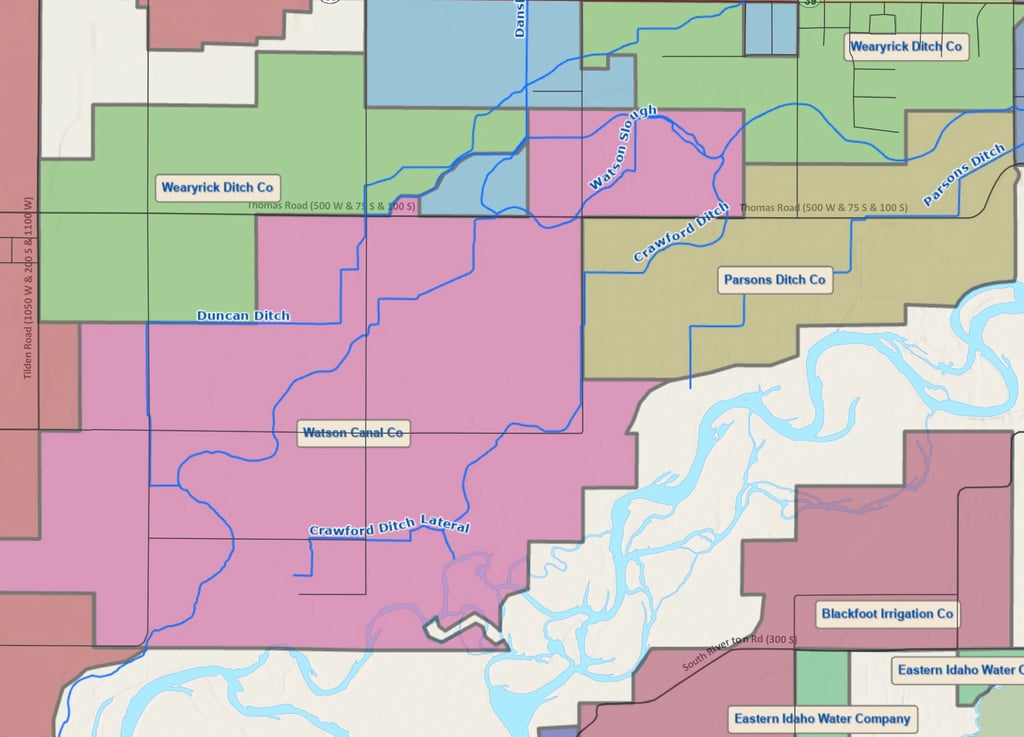
You may be familiar with the names 'Parsons Ditch' and 'Watson Slough', two of the smaller—and earliest—area irrigation systems on the west side of the Snake River in Bingham County. They carry not only water to the farmers along them but a history of their namesakes—Isham Alphes Parsons (and his extensive family) and Big John Watson, whose notions of water ownership (as is commonly the case when irrigation interests abut) differed.
The Parsons Ditch was built in 1885 at a cost of one thousand dollars by Isham Parsons, Homer Laliberty, and Emergy Larocque. Three miles long, it carried 1600 inches of water and irrigated 800 acres that included those builders' properties. The accompanying image shows the farmland now irrigated by the Parsons Ditch, an area that abuts the Watson Slough acreage to its south. Just north of the Parsons Ditch area is the town of Riverside.
Isham Parsons was 35 when he helped build the canal. one of five Parsons brothers from North Carolina who settled the area—William, Robert, Joseph and George Parsons. Joseph had come first, making just-established Blackfoot his home in 1878, building a two room log house and running the city's first brick kiln. Joseph had years earlier been the Sheriff of Decatur County, Illinois, when his brother James shot a man in a dispute over a dog. After freeing him from jail they absconded to Texas, Joseph eventually heading West to Blackfoot. Joseph was also a faith doctor whose services were in great demand. His oldest daughter, Martha Ann, was the settlement's first teacher, founding a subscription school that met in John Montgomery's living room.
Isham Alphes Parsons was the second brother to settle in Blackfoot in 1881, building on the Snake River's bank southeast of the present bridge site. Another brother, Robert, followed in the spring of 1885. Married eight years with three children, he left a home and peach orchard in Boxelder County, Utah, where he and his brother, George, cared for the Mormon Church cattle herd and where Robert sold his fruit door to door.
Robert loaded his wagon with homesteading implements, temporarily left his family and joined a caravan heading north. It left Brigham City and traveled through Malad to Blackfoot, the trip taking three days and two nights. Upon arriving in Blackfoot, he was anxious to file on the rich land west of the river, over which a large toll bridge had just been completed. To save money, he made his first trip on foot, saving the three dollars it cost to cross with a team and the fifty cents it cost to go by horseback. Pedestrians crossed for free. The Hansens, who lived in a one room house southeast of the bridge, were the watchful custodians, Mr. Hansen standing with his hand out ready to collect and his wife always having a happy "good morning."
Robert went west along the river through dense willows and underbrush, finding the district settled westward for three miles. He continued on, the road rough and winding through dry creek beds, boulders, river brush, deep bogs and swift streams. Beyond south Riverside the road turned into a cattle trail that few people traveled. He went onward a couple more miles, left the River and went due west for about a mile. In every direction he saw only a vast expanse of sage brush with no end.
He took time to examine the country closely, knew the soil must be rich and deep to produce such tall sage brush, and staked out a 160 acre claim. Shortly after, he secured another 160 acres southwest of the Wilson School. The timing of his claim gave him the honor of being the second settler in the Thomas district. There was no one within three miles to the east or and three and a half miles to the southwest—there, "Big John" Watson had located on a livestock farm.
Robert made his first home west of the Wilson School building, digging a cellar with "straight even walls." He covered the roof with timber, heaped dirt over the timber. Since there were no windows, Robert would open the heavy, east-facing door for light. He grubbed out a patch of brush nearby and planted a garden, hauled water to it from the nearest stream.
Robert Parson's mother-in-law had been one of the notorious Bill Hickman's ten wives. Hickman claimed to have performed over fifty murders at Brigham Young's request, his public pronouncement—which would lead to a Grand Jury subpoena of Young—putting him in disfavor with Young and freeing all (including Parson's mother-in-law) but one wife from matrimony. Parsons courted the daughter, Henrietta, who, despite being a devout Mormon who had received her 'washings and anointings" years earlier, would choose love of the non-believer Robert over the Church's proscription to avoid marrying 'outsiders'—it "caused her a great amount of sorrow and a great amount of mental suffering."
Once in Idaho, Robert and Henrietta had many obstacles to overcome, lack of water for the crops being primary. Big John Watson would be an impediment to that water.
Big John, a cattleman, was the first man to stake a Thomas district homestead claim. He had brought his cattle in 1880 and they grazed meadow land where the present-day Watson Slough enters the Snake River. Watson, born in Missouri, was thought by many to be part Cherokee Indian and came west as a stage line driver. He continued that work on western routes before first settling on a cattle ranch near Arimo. While living there, Big John was made deputy sheriff of Oneida County, an area which in 1864 took in all of the territory of Idaho, from the Utah line to the Canadian border. Big John reputedly was a man without fear and while serving as deputy sheriff became adversely acquainted with the Mormon people—he came to hate them or any associated with them, and it pleased him to serve Fred Dubois in his campaign to wipe out polygamy in the 1880s. He planned, directed, and led many of the Dubois raids on polygamist families, both in Idaho and northern Utah.
When Big John came to the Thomas district, he constructed a dam on the slough not far from his property, making diversion ditches to irrigate his meadow land. After the new homesteaders began to settle above him (i.e., Robert Parsons), he filed for all the water that flowed through the Watson Slough in 1888 but other homesteaders had filed in the two years prior. His filing was subsequently turned down.
Big John, by many accounts a fearless man without pity, purportedly caused his neighboring settlers a great amount of trouble which came to a head when Jake Hoover, a new Riverside settler with a great animosity for Watson, confronted him in his buckboard one evening while he was driving home from Blackfoot. Hoover stepped into the road, pointed a gun at John's head, fired and missed—but struck and killed one of his horses. Watson, until his death years later, was not quite so fearless—or so it was said.
His brother Richard might have said otherwise, as in April of 1889 he and Homer Laliberty had a kerfuffle with John over the Watson Slough water. Richard and Laliberty had been working on the dam that diverted water from the river to the slough, a dam that had failed and been rebuilt numerous times with increasing animosity between parties. Displeased, John and his son George began dismantling the dam when Richard came at him with an ax. John struck him with the flat of his shovel, Richard's reply with the ax striking John's skull above his left ear. John fell, Richard axed him again, knocking out an inch and a quarter piece of his skull. Richard and Laliberty were arrested.
Watson survived the attempted fratricide, would sell out to the McBride brothers in 1905 and relocate to Otis (now the Sterling area) where the Mormon influence lessened and the Presbyterians still reigned. He had "a big cattle ranch" and drove a "flying machine of the Studebaker-Mustang style with triple-motor-brakeless attachment." He was described as being "three feet one way and six feet the other", weighing over three hundred pounds, and he admitted his ground was on the market and "no good", so rocky that "only snakes and chipmunks could live on it."
Once settled, Robert Parsons solicited others from his old haunts—he had been a railroad foreman in Montana as well as working and orcharding in Brigham City—to come to the area, among the first a young unmarried John Henry Stander. In the fall of 1885 Stander filed on 160 acres of land north of Robert's. The Wearywicks came shortly after and settled west of Robert's land. The next irrigation system north of the Parsons Ditch bears their name.
Robert’s youngest brother, Alph Parsons, took up a homestead in the Thomas district one mile due north of Robert’s and William Parsons located in the present Thomas townsite, one and a half miles west. Robert's sister and her husband Thomas Duncan settled two miles southwest. James and Mary (Robert's parents) lived in Riverside where the store would be located. Alph Parsons donated the land for the Thomas-Riverside Cemetery where his father was the first to be buried.
The Parsons family extended onward toward Aberdeen. George Parsons mined on the flats early in the twentieth century until the American Falls Reservoir was built, inundating it. His son John ran a Ferry (the accompanying photo shows it as it was being built) from Aberdeen to Horse Island in the latter teens.
John's brother, Joseph, would be killed at age 16 on the baseball field in 1929. He was running from second to third base when the catcher's throw struck his skull, putting him in a coma before he died.
Information from this post derives heavily from ROBERT NELSON PARSONS “THE SECOND SETTLER IN THOMAS, BINGHAM COUNTY, IDAHO” BY HIS GRAND-DAUGHTER, GRACE FJELDSTED LOWE and HISTORY OF MARTHA ABANATHA PARSONS FJELDSTED by GRACE FJELDSTED LOWE. Photos come from Ancestry.com and the Canal System map is derived from the Bingham County Parcel Map